Thursday, 26 November 2015

Bali Batik Picnic Dress


I love summer dresses. They're light and fun, and the warm weather is a great excuse to use lots of colour and print (although I'll happily use lots of colour and print in winter, too). Summer dresses are also often quite simple in their styling and quick to make, which is great when you want something new for a heatwave. Sydney's already had a number of very hot days and it's still technically spring, so I can see a few more hot weather dresses in my near future.


My brother and sister-in-law bought me a couple of pieces of batik fabric when they went to
Indonesia earlier this year. This is the first one I've used. I decided that given it's a fabric from a hot weather country, it had to be made into a hot weather dress. I love the rich blue colour, but I'm not really sure what the print is meant to be. There's floral vines and then three other prints that look like a beer stein, a quiver of arrows, and some sort of griffin, but I could be wrong.

The fabric has finished selvedges on all four edges, so I made as much use of that as I could. Those selvedges have been used for the hem, the top of the bodice, and even the zipper and centre back seam. I even used the finished side edge that makes the centre back seam/zipper for the back join of the straps. It's not noticeable unless you look closely - you can just see it in the left of this photo - but I thought it would be a nice touch.


The pattern is Queen of Darts' Picnic Dress, which is a fairly simple, very timeless cut. It looks like it could be from any decade since the 1940s. It's a seven piece princess seamed bodice - front piece, and two each of side front, side back, and back - and then straps and dirndl-style skirt. The instructions are pretty minimal so it's not for a complete beginner, but as long as you know fairly basic sewing techniques it's easy to do.

The pattern is free, but it's only in the one size. Lucky for me, I'm pretty much the same size as Alice. I am a bit taller, though, so I added 1.5cm to the length of the bodice so it sits at my waist. I also made my straps a bit wider partly to show more of the print, partly because the spaghetti-thin straps are fiddly to do. Because the fabric had finished selvedges I simply used the full length of the fabric for the skirt, so no finishing was needed for the hem or centre back seam.


The one thing I didn't think of while sewing the bodice was the seams. Because I was using the selvedge, I obviously don't have any facings, so I thought the seam allowances might show. Rather than unpick and redo the bodice, I did flat felled seams. I trimmed half off one side of the seam allowance, folded the other half over it, and stitched it down, with the stitching line on the side towards the back of the dress. This keeps everything neat and out of the way. If you look closely in this photo you might be able to see the royal blue lines. In the end, it's an accident that I can pretend is a feature.


Although it's been washed a few times the fabric is still slightly starchy, but it should soften up quickly. The skirt also liked catching the wind when I was taking these photos. Because it's a batik and not produced using more industrial techniques it did have a fair bit of loose dye the first time I washed the fabric, but it's been soaked two more times and barely leaves any dye, which is great.


 I really like the shape of this dress. It's simple but not boring, feminine but not fussy. It would be nice if it had pockets, but given that the skirt is only a single piece I didn't have any side seams in which to add them. I thought briefly about adding patch pockets to the front, but decided not to because I want to keep it as clean as possible. If I reuse this pattern I will probably add side pockets, but I'm happy with this one without them.


 It was once again stupidly hot while taking these pictures, almost mid-30s with a hot wind at 9:30am, but the dress is wonderfully cool. The fabric is pretty thin, almost a lawn weight, so it's very comfortable and light to wear. It kept me nice of comfortable for the whole rest of the day in the heat.


Wednesday, 18 November 2015

Cooling Breezy Rayon Top

Ah, summer. Here you are. It's stupidly hot in Sydney right now, so luckily my latest make is a very soft and lightweight top.

The fabric is the first of the ones I've been planning to use this summer, one of six fabrics on my upcoming projects page. This rayon jersey was bought at Spotlight on clearance. It's beautifully soft and I love the print, but it's fairly thin and very stretchy and really doesn't like holding any shape at all.


The pattern is Simplicity 2261 which is no longer in print, but is a collection of three different jersey tops, one pair of pants, and one skirt. I've made top A, but with a little modification. The pattern is meant to be double layered, but the piece of fabric I had wasn't large enough for a top layer. And honestly, I think it would have been too heavy, anyway. I was wanting a very airy top for hot days, and extra layers of fabric would defeat the purpose. The pattern also suggests adding a trim or two on the yoke pieces, so I had a look through the bits of ribbon and rickrack I own to find anything that matched. But the print is already enough and doesn't need any additions, so I left that off.


Because the jersey is so stretchy, I had a few problems with the yoke. The yoke is two layers, but only the facing has interfacing applied. But this jersey is so soft and stretchy that it had pulled a bit out of shape just by attaching the front and back pieces to the yoke. The back was ok to stitch on, but I had to baste the front yoke and gather it slightly so that it would attach properly to the facing. And even with that, it doesn't quite sit flat, although it's not too noticeable.


The good thing is, though, the top is wonderfully cool in the heat. Because it's basically a trapeze gathered in the centre, it's loose and allows a lot of airflow. It also picks up any bit of breeze which is great when it's 38 degrees (100 Fahrenheit) with a very bright sun.

 There's probably more I could say about this top, but it's too hot right now to think of anything else. All that really matters is it's very hot here, but this top keeps me thankfully (relatively) cool. Which is very welcome.


Friday, 6 November 2015

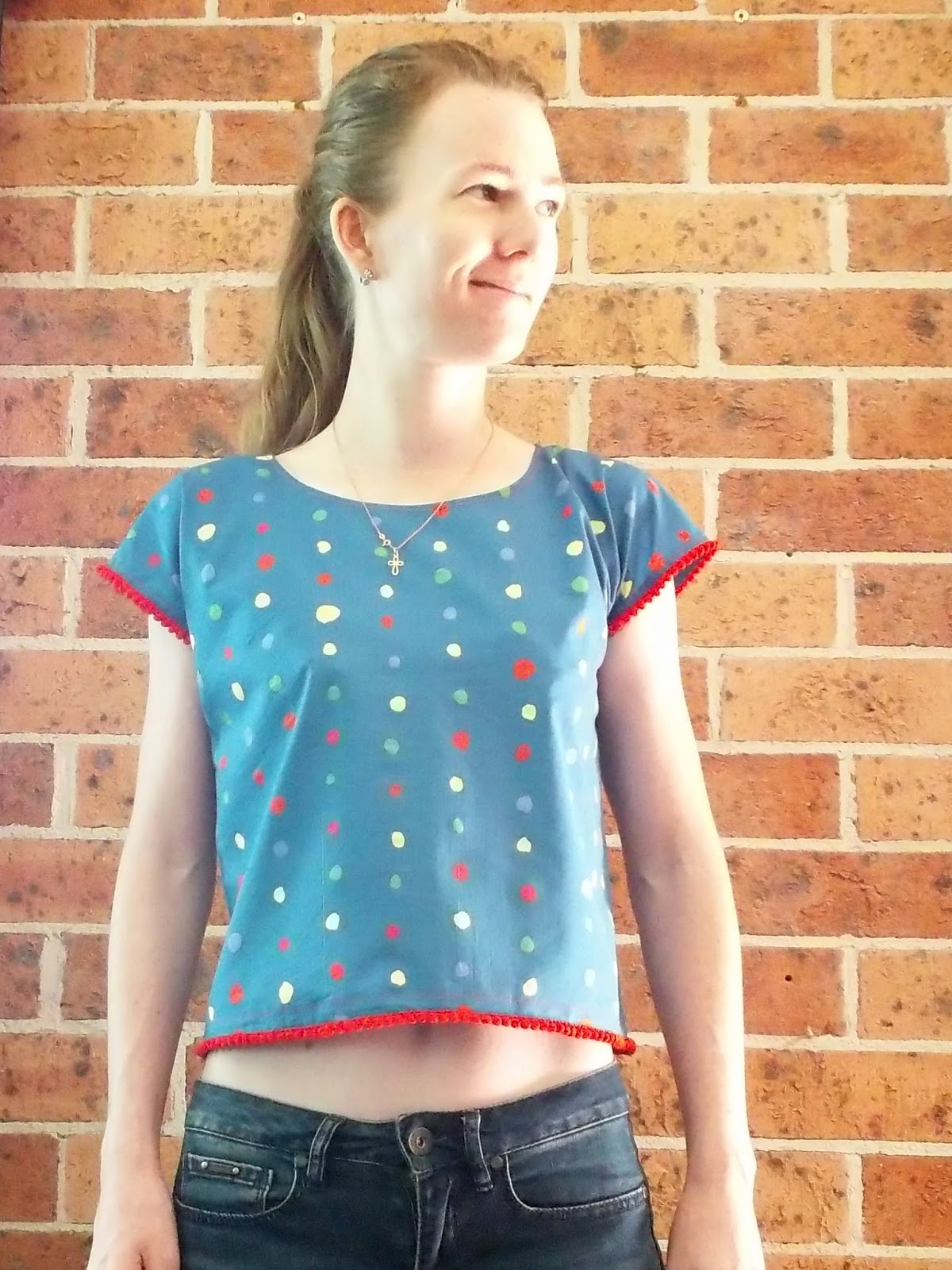
Cropped Nani Iro Top


There are a few fabric brands that are lovely but pricier, which daunt me a little from buying them. I buy some of my fabric and quite a few patterns and zippers from op shops, so expensive fabric is a bit scary. Nani Iro is one of those brands that have daunted me, because the fabrics are so nice and I don't want to screw it up. But when Tessuti Fabrics got some new Nani Iro in earlier in the year I just could resist buying a little bit. The fabric is the blue Sazanami Pocho, Tessuti still have the pink.


I didn't have much money to spend, so I only bought half a metre. I'm quite little, and I didn't want to make anything complicated anyway, just a simple top. Originally I'd been thinking of doing something sleeveless, a shell or tank top. But I wasn't really certain what I wanted to do, and it was winter, anyway, not really the time of year to be making light and airy tops. So I put my little piece of Nani Iro away in my stash for a later date when I had a better idea of what to do, and when the weather was right to wear it.


I was still thinking every so often about exactly what to make, taking in influences from what I saw on other blogs, Instagram, and even in shop catalogues. I decided that the top would be unstructured, and that to complement that I'd make it just slightly cropped. I'd also seen a bunch of tops with pompom trims on them and really liked the idea, so went to see if I could find a trim that would match some of the spots. Spotlight had this red pompom trim that seemed a perfect match.


I thought the pompom trim would look better on sleeves than on a sleeveless tank. I still didn't want to have multiple pieces to the pattern, so I simply started cutting two matching rectangles but added an extra inch of width at the top for all-in-one sleeves. Easy and lazy. For the neckline I just did trial and error, cutting the curves of both front and back pieces down. The back was right first time, but I lowered the front neckline slightly from where I first cut it. I did think about making it a deep scoop, but in the end decided I liked how it sat just below my collar bones.

After that, it was very fast to put together. Given it's just two pieces there wasn't much sewing at all. I used red threat to match both the red spots and the pompom trim. Normally I avoid visible stitching, but I thought it would complement this fabric and this top well.


This was an extremely fast make - about an hour, compared to the huge time and effort on my last make, the DuBarry dress. The attention to detail required for a long make is really rewarding when you get it done, but short and fast makes like this top are great because you have something to show off so soon after you started.


Tuesday, 27 October 2015

Averting Disaster in a Denim DuBarry

Getting this made was a bit of a saga. It's meant to be a transseasonal piece, but it's only now been finished, at the end of October. The pattern is early 1940s, but the denim and shortened hem takes it via the 1970s.

The pattern is one I bought at a vintage fair about four years ago, but have been a bit scared to use. It's DuBarry 5265, and it's extremely elegant. DuBarry was a pattern brand produced by Simplicity in the 1930s-40s, and they're hard to find and often pricey. This is the only one I own, and it's from 1942, so I'd been saving it until I found something I really wanted to sew it with. And so obviously denim was the perfect match for a classy 1940s pattern. I kind of think that the designers of the DuBarry patterns might be a bit horrified at making a dress out of - gasp! - denim, but I'm really happy with the choice of fabric.


I've been scared of working with denim for years. I've used almost every other fabric happily, even tricky fabrics like lace, lycra, velvet, and sequins with no problems. But denim? I've taken up jeans once or twice and it was a horrible experience. But I decided I wanted to conquer that fear and be able to use denim myself. Seeing lots of other sewing bloggers who've made their own jeans, denim jackets, etc, I wanted to join in the fun.

This lightweight denim is from Spotlight. I chose it because of the criss-crossed diamond/grid pattern and its nice dark wash. I thought that I'd make the diamonds match up nicely along the princess seams of the coat dress, and it would look fantatic. Well, after much frustration folding the fabric this way and that, I discovered that the grid lines are completely uneven! It was absolutely impossible to fold the fabric in a way that would let me get even the same pieces to have matching lines, let alone matching each piece's seams to its neighbouring piece. Coupled with the fabric being cut on a slight diagonal and undersized by the sales assistant, fitting the pattern pieces on the fabric was going to be difficult.


And then I compounded it all by for some stupid reason cutting out four side back pieces, and missing the centre front pieces. I didn't have enough fabric left over for the centre front pieces, and the pattern piece wouldn't fit properly on the extra side back pieces, so I was a bit stuck. And I still hadn't cut out the front facings, either, or the sleeves.  I didn't want to trek back to Spotlight just to get another foot of the fabric, so I looked at the extra side back pieces as well as the scrappy bits of fabric I had left to see what I could do. I had one rectangular piece about 60cm long left, which was good for the sleeves. Because that piece was smaller, those are probably the only part of the dress where the gridlines of the two sides actually match.


The centre front and front facings were going to be harder. I couldn't fit either pattern piece completely on the side back pieces, and I didn't have any offcuts large enough for them, either. In the end I realised I simply didn't have enough of the denim to cut all four pieces out completely. The facings were going to have to be at least partly in another fabric. Because the top of the facings is visible as part of the collar, I wanted them to be denim, but the rest of it could be in another fabric. So I focused first on the centre front pieces. They were going to have to be cut as two halves, joined at the waistline. So I marked the waistline on my pattern piece, and then cut the top halves out on my extra side back pieces, and the bottom halves on some of the leftover denim. I was then able to use the last bits of the extra side back pieces to cut out just enough of the front facings for the collar and top button - genuinely the exact minimum fabric I needed. It pays to be economical with pattern placement and fabric use! For the rest of the facings I was planning to be sensible and use something neutral, but going through my box of leftover fabric I found this one near the top and just couldn't resist. But pink and blue flowers on a bright yellow background is just so much better than navy or black cotton.


I have to confess that when I cut out this dress I didn't actually own jeans needles. I had some new size 14 and 16 needles, and the denim is lightweight, so I thought I'd give it a shot with them.
No. Bad idea.
It worked okay to join the two centre front pieces, but when I tried to do a seam my thread broke after about 10cm. The pattern does say that the dress is meant to hang basted (or, in my case, pinned) together for a minimum of 24 hours so that the hem can settle. It ended up being closer to 24 days by the time I'd bought jeans needles, made mum's dress, and was able to get back to this. But once I had the jeans needles, it sewed up like a dream. I'm sure those of you who've sewn with denim before are rolling your eyes at my bad sewing laziness, but at least I've now been converted to jeans needles.


I made a couple of changes to the pattern. As with all early 1940s patterns, the hem for this coat dress was originally below the knees. It's not really a length I like, not that I had enough fabric for it, anyway. So I shortened the hem to finish just above the knee, which makes it more wearable and fresh. I also decided on elbow length sleeves, rather than the short or long sleeve options of the pattern. The sleeves are also slightly narrowed in, because the original sleeves are gathered at the cuff. The sleeves also have fairly full sleeve heads which I was worried would be too puffy, but they're actually not all that big. But they do allow full movement in all directions with no pulling, which not all dress patterns do.


All the seams are once again French seams. Given this is a coat dress (and one that also works well as a coat), I wanted the seams to have a more polished finish, and I think the French seams do that. Of course it added a lot to the time it took to make the dress, and a bit of thought to the order I needed to do the seams in, but the final look is just right. The facings and hem are hand stitched, which took hours. In total there's got to be more than 20 hourse of sewing - both machine and hand - in this dress.


For the buttons, I decided that I wanted something that suited the denim more than that 1940s. This dress is basically vintage-modern, rather than vintage-costume, so I didn't think about matching the era. I briefly thought about metal buttons like jeans and denim jackets have, but decided they'd stand out too much, rather than blending in to the dress. So my next thought was dark wood. I didn't own any, so next time I was in the city I had a look in Lincraft at their button selection. They had some wood buttons, but they were all either too small, or too big, or too light. Then I spotted these coconut shell ones. I've actually used the back, rather than the lighter front, but they were just the colour and feel I wanted.


It's a coat dress, but making it with denim it really does work as both a coat and a dress. And yes, I am wearing it here with jeans so it is double denim - but at least they're maroon leopard print skinny jeans.


The wildly varying light levels in the photos are because of the weather. After storms yesterday and morning showers, I managed to catch a break in the rain, so the sun was sometimes out, sometimes behind the clouds, pretty much changing between every shot.

This took a long time and a lot of work to make, but final product does, I think, make up for the time and stress. And although it's a coat dress, it works as both a coat and a dress, so two items for the price of one! But definitely the effort of five.


Friday, 16 October 2015

Mum's Escher-esque Print Dress


Most of my sewing is selfish sewing. I started sewing to make things I wanted to wear because I found what was in shops boring or expensive, and have pretty much kept to making things just for me. But this year I've made a couple of things for others. This is the first one to make it on to my blog: a dress for my mum.


This fabric, as with that used for my beach romper and casual pants was bought in Benalla years ago when I was doing fieldwork there. I bought it even though I knew the colour really wasn't me - bright orangey-tomato red doesn't particularly work with my paleness - but the print, which looks like some sort of Op-Art/Escher mix is just amazing. And at $5 a metre, too hard to resist, so I bought some.


The fabric was always going to work best on my mum. Her skin tone, hair, and eyes really suit reds and oranges. But it's taken me a long time to get around to making this dress for her - the fabric was even sitting out near my machine for a good three months before getting started on making it. Part of that was choosing the right pattern. Obviously I wanted to keep the seam and dart lines to a minimum so they didn't distract from or mess up the print. That meant choosing a simple shift dress, but surprisingly I don't have many of those, and none that were quite what I wanted. In the end I used Simplicity 7380, a vintage 1967 pattern, as a base and made some changes.


What I liked about Simplicity 7380 as a pattern were the double darts, with both a normal bust dart and French darts, which give just a little bit of extra shaping while remaining relatively unstructured. But the pattern is also high-necked and with sleeves, neither of which I wanted. Changing the neckline was simple, I just cut the piece lower in the front, but for the armholes I wanted little fake cap sleeves. To do that, I used my French curve to taper the shoulder pieces out and down, and redrafted the armscye from the side seam up to the new shoulder seam. The pattern was also a smaller size than needed, so I did the terribly lazy upsizing by simply placing the two pattern pieces about an inch back from the fold and cutting it out like that. Horribly bad practice, I know, but it worked, so all's fine, right?


Another reason it took a while to get around to making this dress was that the fabric frays a lot. It's fairly structured with a thick but loose weave (a cotton duck, maybe?), so I definitely had to do something to stop it fraying. I decided the best option was to cover the seams in bias binding. And for the zipper, I double folded the fabric so that the raw edge is hidden inside the stitching. It meant it took longer to make this dress than it would have otherwise, but it should also mean it's wearable for longer and doesn't need repairs. And it means the insides look much prettier, too. The arm and neck facings and hem were also hand sewn so there would be no visible stitching distracting from the print of the fabric, to keep the clean lines.


I also did my best to try and pattern match the print when putting this together. I couldn't quite get it perfect to the point of being invisible, but I at least made sure the horizontal lines matched up for the back seam and the side seams below the darts. If I'd had more fabric I might have been able to match with the diagonal lines and triangles as well, but I didn't. And it would have been quite a bit of extra effort for something only noticeable if you look really closely. But the horizontal lines did come in handy for the hem - I didn't have to do any measuring, I could just fold with the line and knew it would come out evenly.


This dress was a simple make, even with the resizing and adjustments. And I'm really glad that I was able to put this fabric to good use, in making a dress in a style and print that suits my mum so well.


Tuesday, 6 October 2015

The Retro Cord Skirt


So it's spring in Sydney, and my plan has been to make a few transseasonal pieces, but the weather isn't agreeing with me. It's decided to go straight into summer, with the temperature being above 35°C since Saturday. So if the warm weather keeps up I might not get that many opportunities to wear this corduroy skirt. It's not exactly heavy, but it's not light or airy, either. Still, I at least got these photos taken one morning before the day heated up too much.


The pattern is vintage Simplicity 8363, from 1969, so it's another vintage pledge make for 2015. I found it for 50c at a local op shop - score! I've found a bunch of patterns, fabric, and zippers at that op shop, it's a real treasure trove. The pattern's a teen size pattern, 25 inch waist which is just bigger than me (I'm a 24), but the slight size difference didn't matter. At most it just means that it sits a bit lower on my waist than it was originally meant to, but it still sits at a completely fine level.


I made view 4 of the pattern, the mini length with one central inverted box pleat. My fabric, a pinky/purple narrow corduroy, is even pretty much the exact same colour as the picture on the envelope - I've basically made the example picture! My piece of corduroy was in my stash, I'm not entirely sure where it came from. It was also just the slightest bit too small for the pattern, so I had to shorten the length by 1cm so I could fit the pattern pieces on. Given I was already making the 'mini' length I thought the skirt may turn out on the short side, but it really isn't. I wouldn't even call the length 'mini'. I guess definitions and skirt lengths have changed since 1969.


The centre pleat normally sits closed and flat, which makes it look a little bit like culottes. But it means there's a bit more room for movement, without being bulkier or fuller. Because the pleat sits flat it was a little hard to photograph how it expands, hence the awkward pulling-my-skirt-open picture below, and the weird pointy toe one further up.


Sewing this up wasn't perfect, though. Am I the only person who has problems sewing corduroy? Although the final outcome of this skirt is fine, I had thread catching and breaking so many times while making this, even after giving my machine a full clean-out. It also frays ridiculously, so the seams are frenched. I had been going to try using my overlocker which I've had for ages but been scared of, but when I threaded it up and tried it out on a piece of scrap fabric, the bottom looper snapped in half. As in the actual piece of metal. No idea how that happened, but obviously there's no overlocking for me at the moment.


I used a metal zipper for the closure. It was another cheap find at the same op shop, also 50c. I thought about buying a matching pinky/purple zip, but I have a lot of zips so I figured I should probably use one I already owned rather than buying more. And I already had everything else that went into making this skirt, including an identical colour thread, so making a special trip just to buy a zipper seemed to be a bit too much effort.


The colour didn't quite turn out right in these last couple of photos, but the at least show some of the close-up and inside detail. The waistband in hand stitched, but the hem is machine stitched. 

Overall, this skirt is probably more cool-weather than I'd imagined, although the corduroy is fairly lightweight. But it's quite versatile, and would work in most weather apart from really hot days. And the colour's nice and bright, which is always important!